How to Use the Advanced BaZi Calculator: Complete Guide
The Advanced BaZi Calculator | 精準八字免費排盤分析 is a charting and analysis tool for the Zi Ping BaZi 《子平八字》 system, powered by the Destiny Engine. It generates the Four Pillars and evaluates the chart through curated rules informed by classical works such as Di Tian Sui 《滴天髓》, Yuan Hai Zi Ping 《淵海子平》, Qiong Tong Bao Jian 《窮通寶鑑》 and Zi Ping Zhen Quan 《子平真詮》. The engine considers Day Master strength, elemental presence, rooting, hidden stems, combinations, clashes, punishments, harms and overall balance, while allowing other analytical methods to be added through its available options. It presents the results in a more organised and structured format for destiny and timing analysis. The calculations use pre-coded rules rather than generative AI approximations. A separate Chinese Name Analysis engine is also included and can reference the birth chart.
Free Edition: Birthchart Input, Birth Chart, Advanced Analysis, Extra Pillars, Chinese Name Analysis
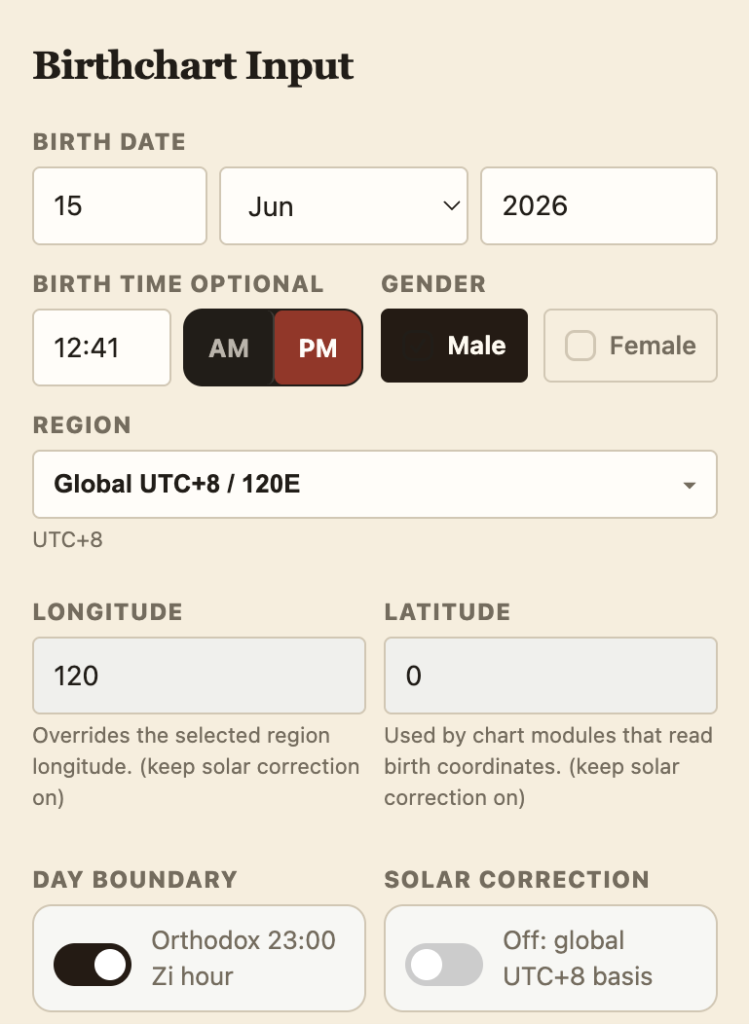
To begin using the Advanced BaZi Calculator users need to fill in the information at Birthchart Input section. These information are needed to calculated a Four Pillars BaZi chart accurately. Users enter their birth date, birth time, gender, and birth region. While birth time is labelled as “optional,” it is actually very important to ensure greater accuracy of the results. All birthdate are based on the Gregorian calendar (or Standard Civil Time calendar). All default brith regions are UTC based. All gender default to a binary. The selected region supplies the standard time-zone and longitude settings used by the calculator, despite the UTC. Manual options to choose Longitude and Latitude are only available for the Premium Edition.
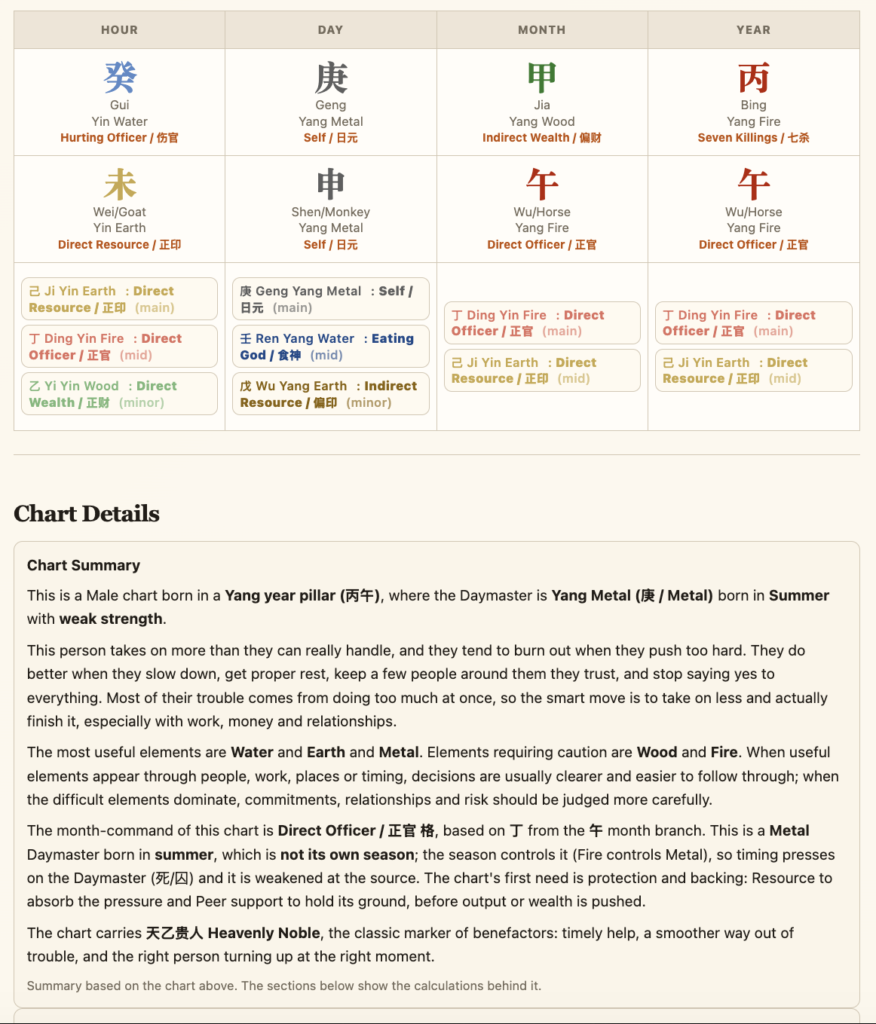
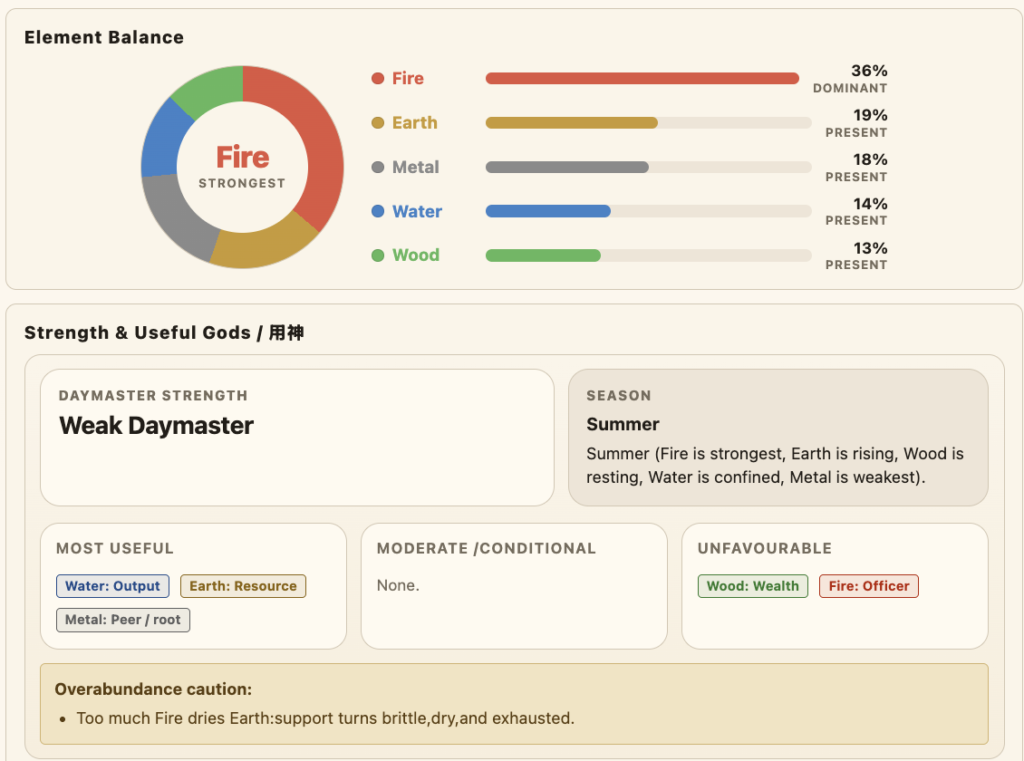
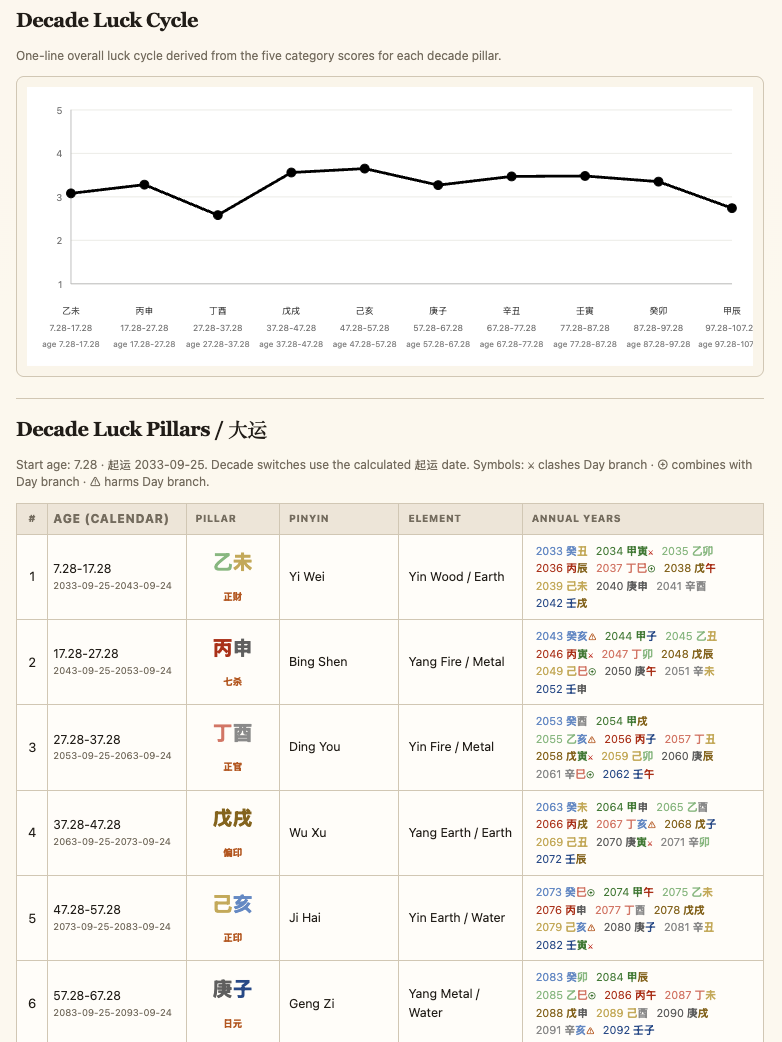
Users may choose the day-boundary method used to determine when a new BaZi day begins. The default follows the orthodox 23:00 Zi hour. It can be toggled for modern 00:00 system. Solar correction is optional and remains switched off by default. When enabled, the calculator adjusts the recorded time using the selected of manually entered longitude. This allows users to compare a standard civil-time chart with one based on local solar time.The General Analysis provides the main interpretation of the birth chart using the Four Pillars of Year, Month, Day and Hour. It identifies the Heavenly Stems, Earthly Branches, hidden stems, Five Elements, Yin–Yang qualities and Ten Gods found in each pillar. From here, the Daymaster is determined, with its polarity, strength, and the chart structure is established, with its useful elements, elemental balance, hidden elemental state, natal clashes, combinations and harms, useful and unfavourable Ten Gods, Decade Luck Cycle (Biorhythm) and Decade Luck Pillars.
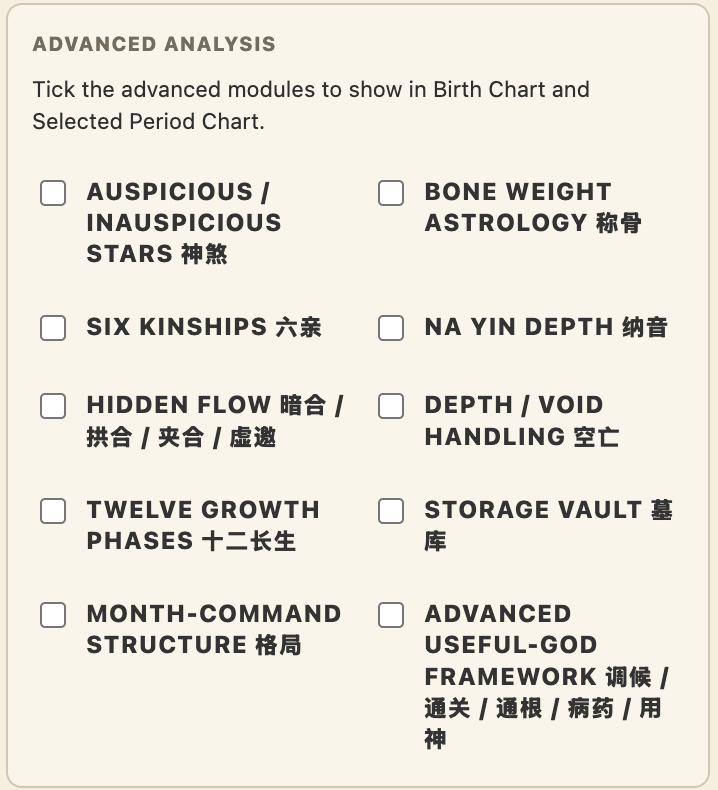
The Advanced Analysis section consists of modules that are largely auxillary to the main Four Pillars of Destiny readings, but who can give extra angle of analysis to the natal chart nevertheless. These can be selected for, and they will appear in the Birth Chart and the Selected Period module (Premium Edition) as extra sections. The available modules include Auspicious and Inauspicious Stars, Bone Weight Astrology, Six Kinships, Children and Projects, Na Yin Depth, Hidden Combinations, Void handling, the Twelve Growth Phases, Storage Vaults, Month-Command Structure, and the Advanced Useful-God Framework. The Advanced Useful-God Framework consists of climate adjustment 调候, elemental mediation 通关, rooting 通根, Disease and Medicine 病药, and Useful God 用神 analysis to identify what the chart most needs for balance and effective expression.
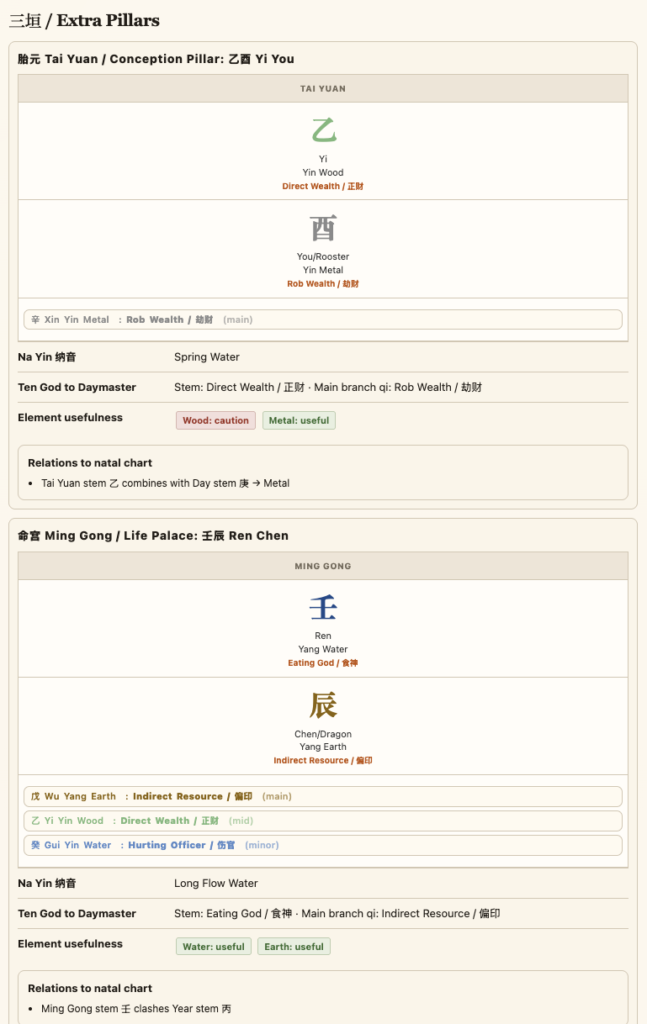
The Extra Pillars section adds three supplementary pillars to the main BaZi birth chart: Tai Yuan 胎元, Ming Gong 命宫 and Shen Gong 身宫. They provide additional context but do not replace the Year, Month, Day and Hour Pillars or alter the chart’s Day Master strength. Tai Yuan, or the Conception Pillar, represents symbolic prenatal influences, inherited foundations and the conditions surrounding a person’s early formation. Ming Gong, or the Life Palace, adds context to a person’s general life direction, working environment, opportunities and the way the chart develops through experience. Shen Gong, or the Body Palace, focuses more on how the chart is expressed through actions, physical effort, practical choices, money behaviour and daily life. These pillars can also be compared with the natal chart and selected timing pillars to identify additional combinations, clashes and supporting influences.
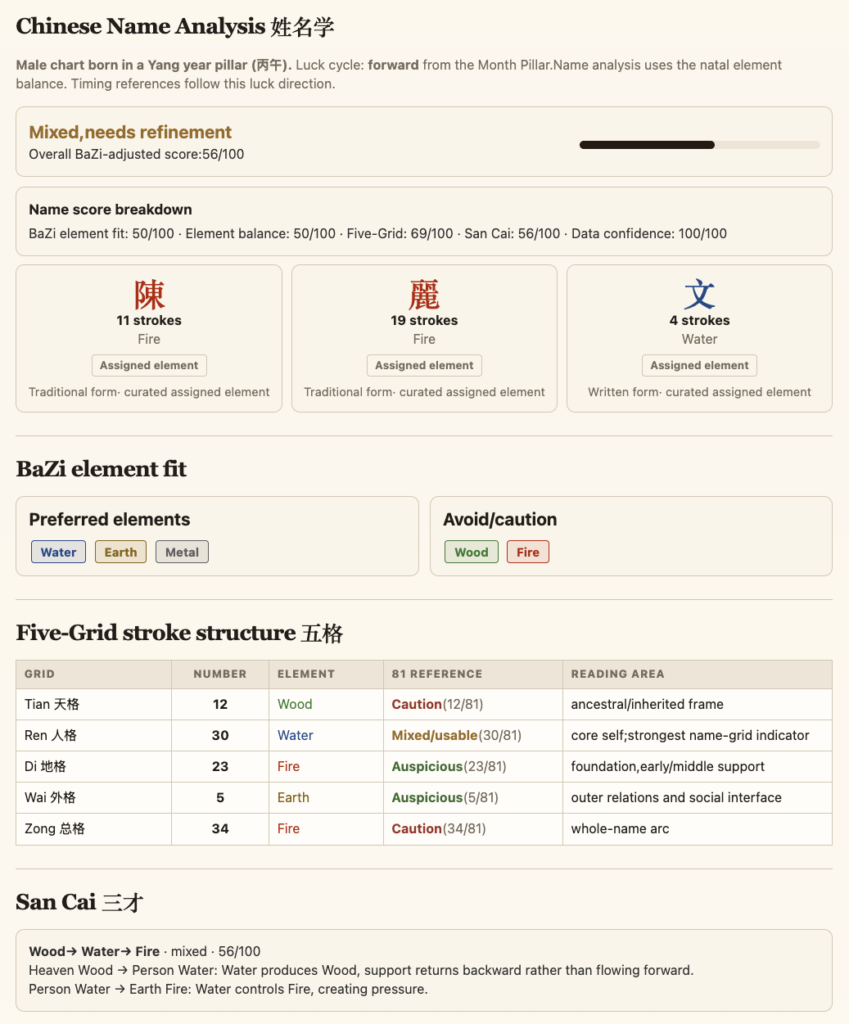
The Chinese Name Analysis, with an internal database of 5,000 Chinese characters from the Kangxi dictionary, examines a Chinese name by evaluating the individual characters, their traditional stroke counts and their associated Five Element qualities. Users enter the surname and given-name characters directly so the calculator can analyse the name as written. The reading calculates the traditional Five-Grid structure: Heaven, Person, Earth, Outer and Total. The numerical patterns are then classified according to their traditional favourable, mixed or difficult meanings. The scoring is also gathered from the San Cai analysis which is increasingly popular in Chinese Name Analysis. Last but not least, the analysis also compares the name’s elements with the person’s BaZi chart, showing whether the name supports useful elements, strengthens an existing imbalance or introduces qualities that are less helpful to the chart.
Premium Edition: Selected Period, Best Year Finder, Benefactors, Compatibility
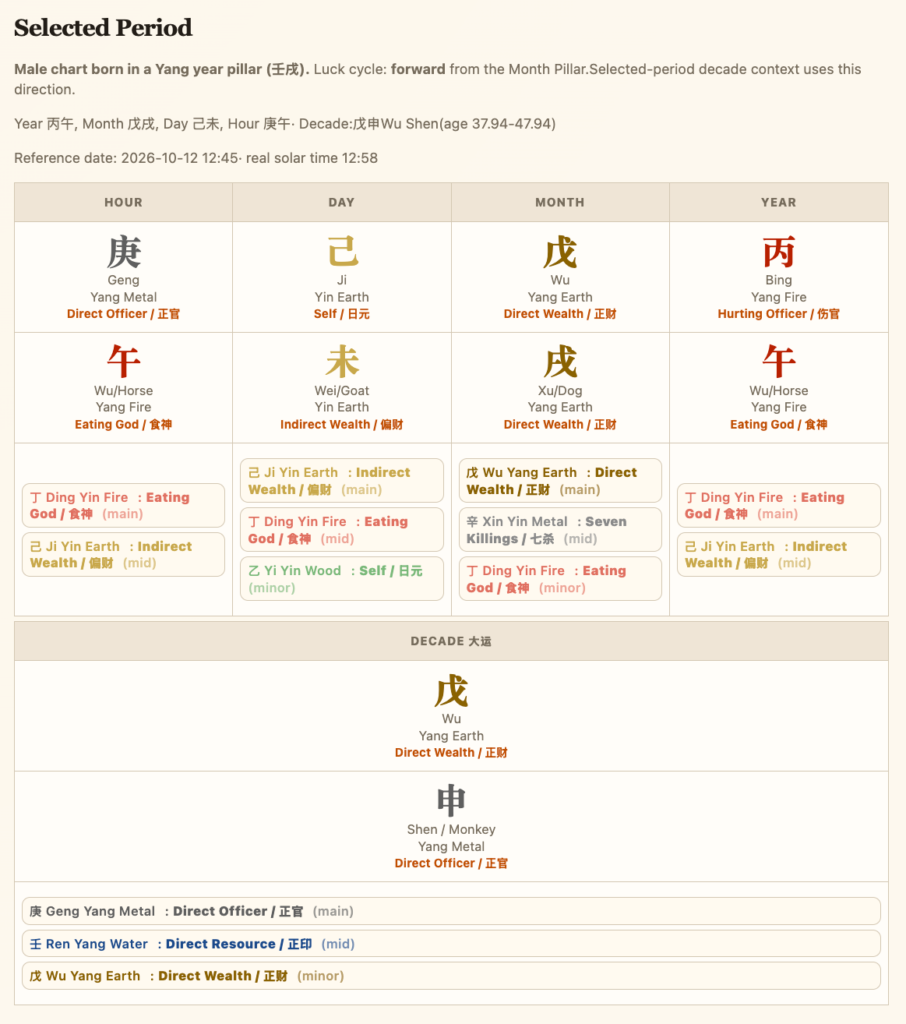
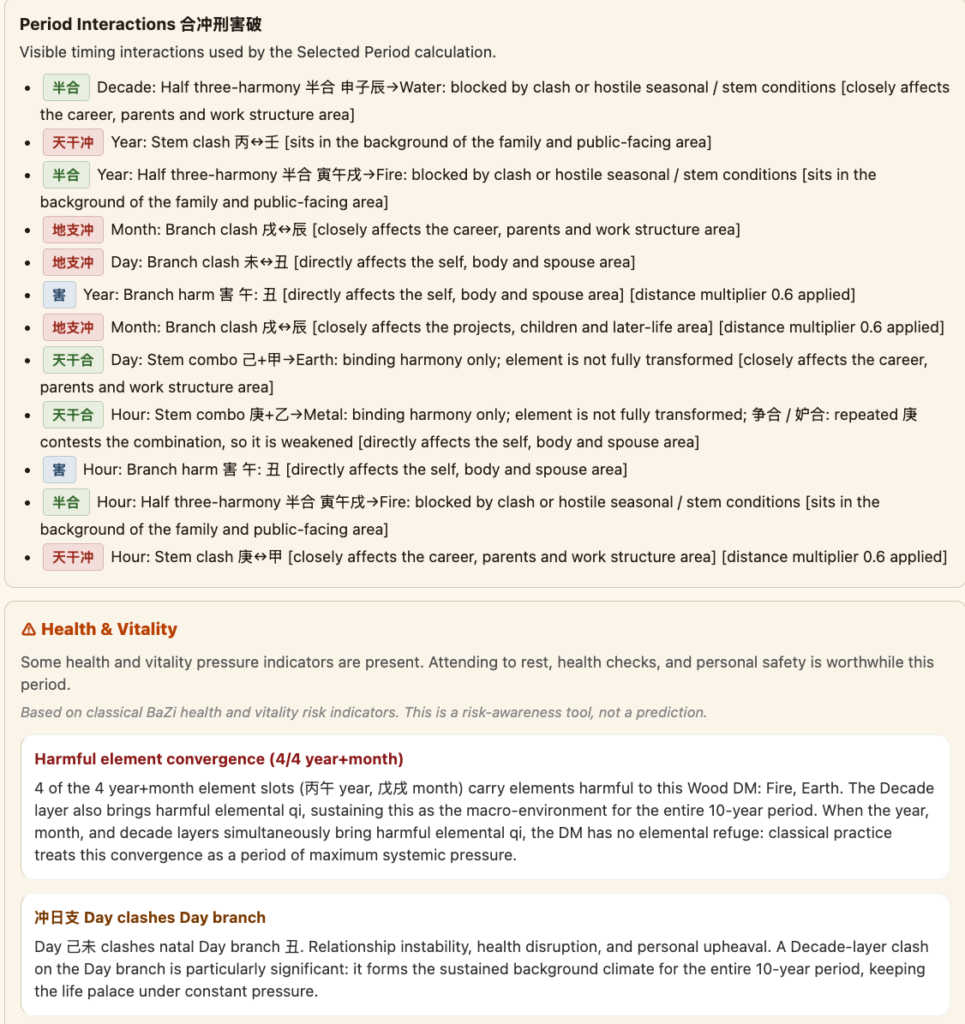
The Selected Periods module examines how a chosen period interacts with the original BaZi birth chart. Users begin by entering a year, then may add a month, day and hour for a more detailed timing analysis. The relevant Decade Luck Pillar is identified automatically from the birth information. The selected timing pillars are then compared with the natal chart to identify combinations, clashes, harms, punishments, branch interactions and changes involving hidden elements. It also considers whether the incoming elements support the chart’s useful influences or strengthen existing pressures. The interpretation explains the main themes activated during the selected period, including career, finance, health, relationships, change and travel. A year-only reading gives a broad overview, while adding the month, day and hour narrows the analysis to a more specific window. Selections from Advanced Analysis will add extra layers and sections to the analysis in this area.
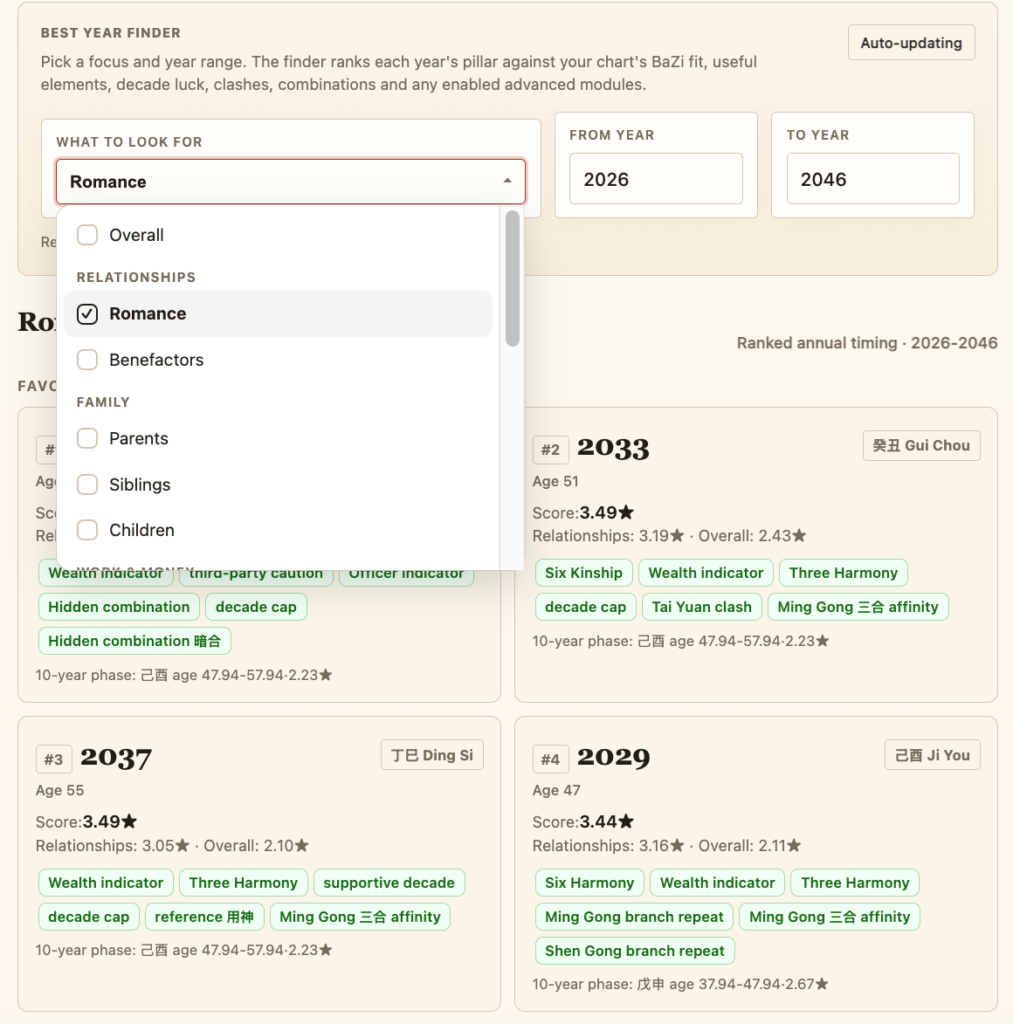
The Best Year Finder searches across a selected range of years to identify periods that are more supportive for a particular goal. Users may evaluate timing for romance, business, employment, health or mental well-being. Each year is compared with the original BaZi birth chart, the active Decade Luck Pillar and the chart’s useful and difficult elements. The module considers the annual Heavenly Stem and Earthly Branch, Ten God relationships, combinations, clashes, harms, punishments, seasonal influence and the way the year affects existing chart structures. Rather than ranking years from a single favourable symbol, the calculator evaluates several factors together. A potentially helpful year may receive a lower ranking when it also strengthens an existing imbalance, activates a serious clash or conflicts with the current decade. Years with excessive pressure or clearly unfavourable interactions are filtered out of the strongest recommendations. Different aspects e.g. relationship is scored differently from career.
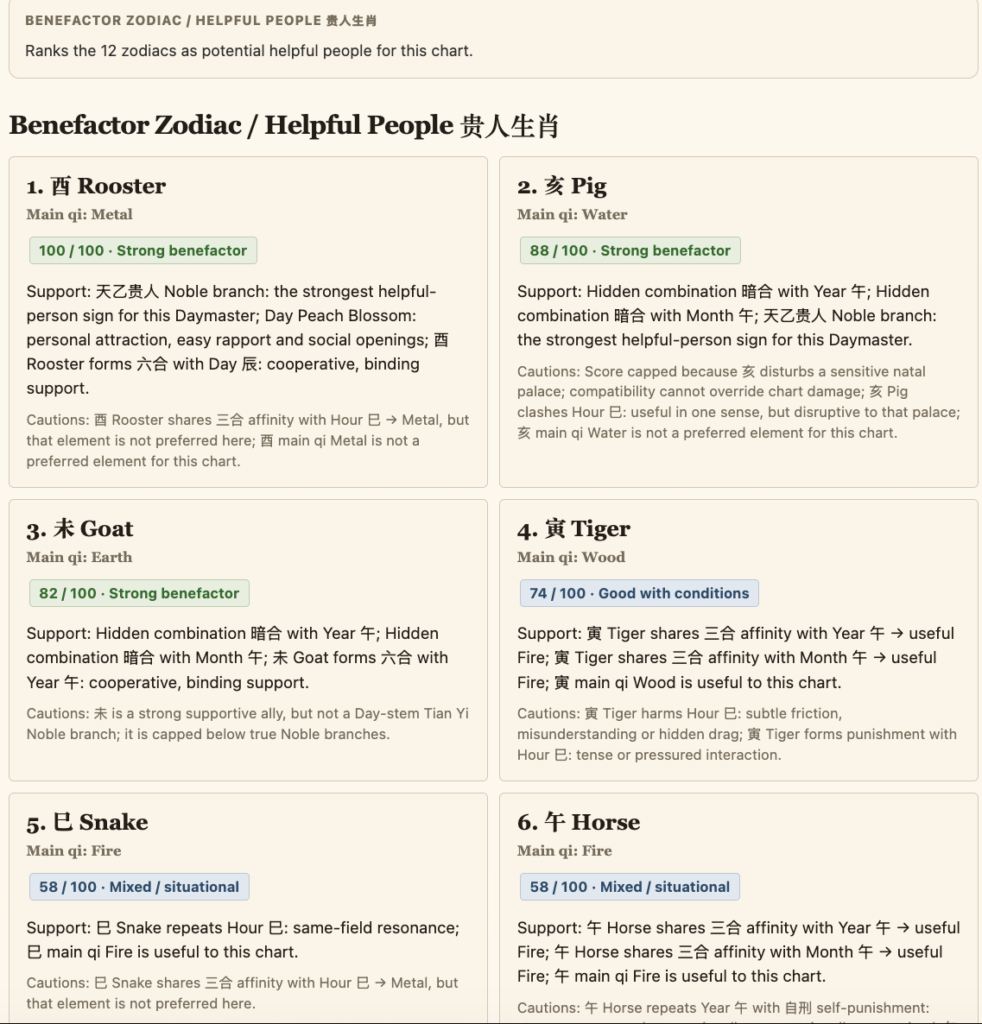
The Benefactors module identifies the people, signs and timing influences that are more likely to support the birth chart. It examines several traditional BaZi indicators rather than relying on a single benefactor star. Using Tian Yi Gui Ren 天乙贵人, one of the main classical benefactor indicators, Peach Blossom indicators, based on both the Day Branch and Year Branch, together with Six Harmony 六合 and Three Harmony 三合 relationships. These connections may point to people who bring cooperation, introductions, emotional support, social opportunities or practical assistance. Each of the twelve Earthly Branches (or Zodiacs) is ranked according to how well it interacts with the birth chart. The ranking considers useful elements, combinations, support to the Daymaster, relationship indicators and any clashes, harms or punishments the branch may introduce.
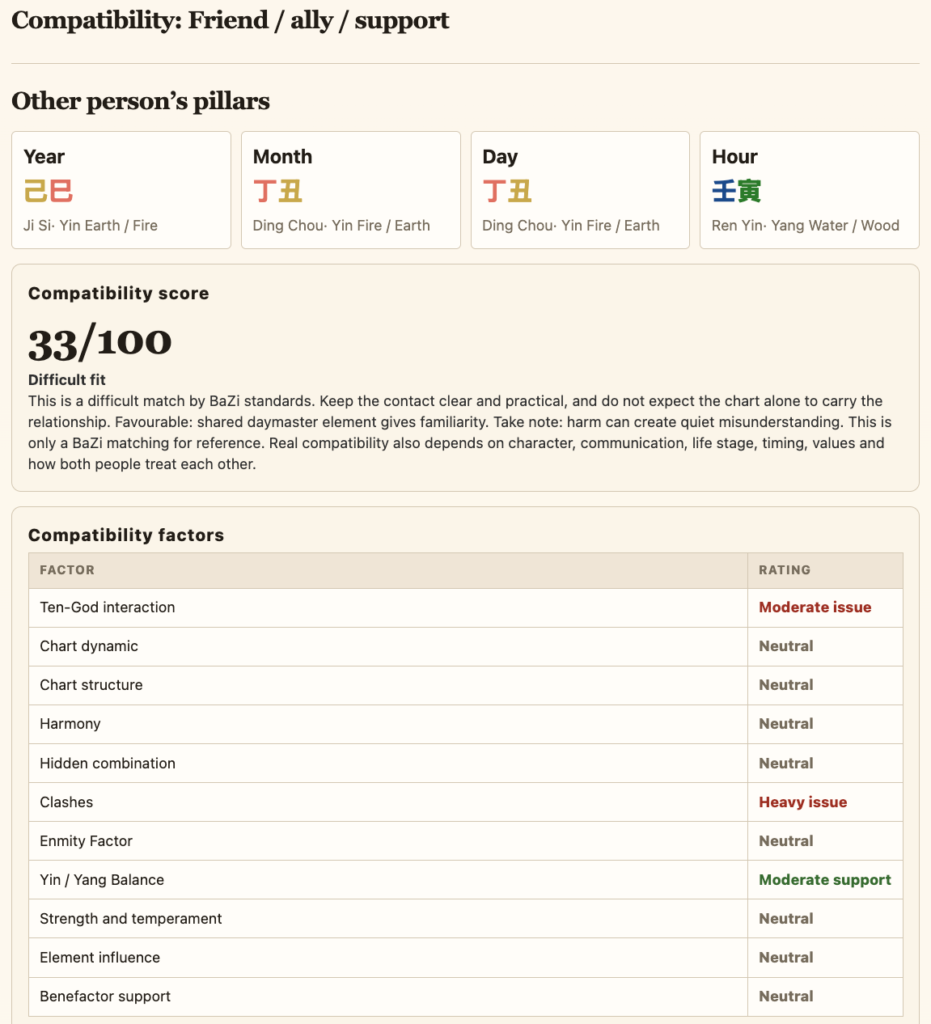
Compatibility module compares two complete BaZi birth charts to examine how the people may relate to one another. The user can select categories ranging from romantic relationships, business partnerships, friendships to workplace relationships and other personal connections. The module then examines each chart from the other person’s perspective. The same individual may appear differently depending on the relationship being studied. For example, a person may activate spouse-related indicators in a romantic reading, Officer influences in a boss relationship, Peer qualities in friendship or Rob Wealth influences in a competitive connection. Gender is also considered where it affects traditional relationship roles. The result explains the strengths, tensions and likely dynamics of the relationship without reducing compatibility to a single score. A strong connection may still contain areas of friction, while a difficult interaction may become manageable when the wider charts provide balance and support.
Premium Edition: Vedic Cross-check and Qimen Direction
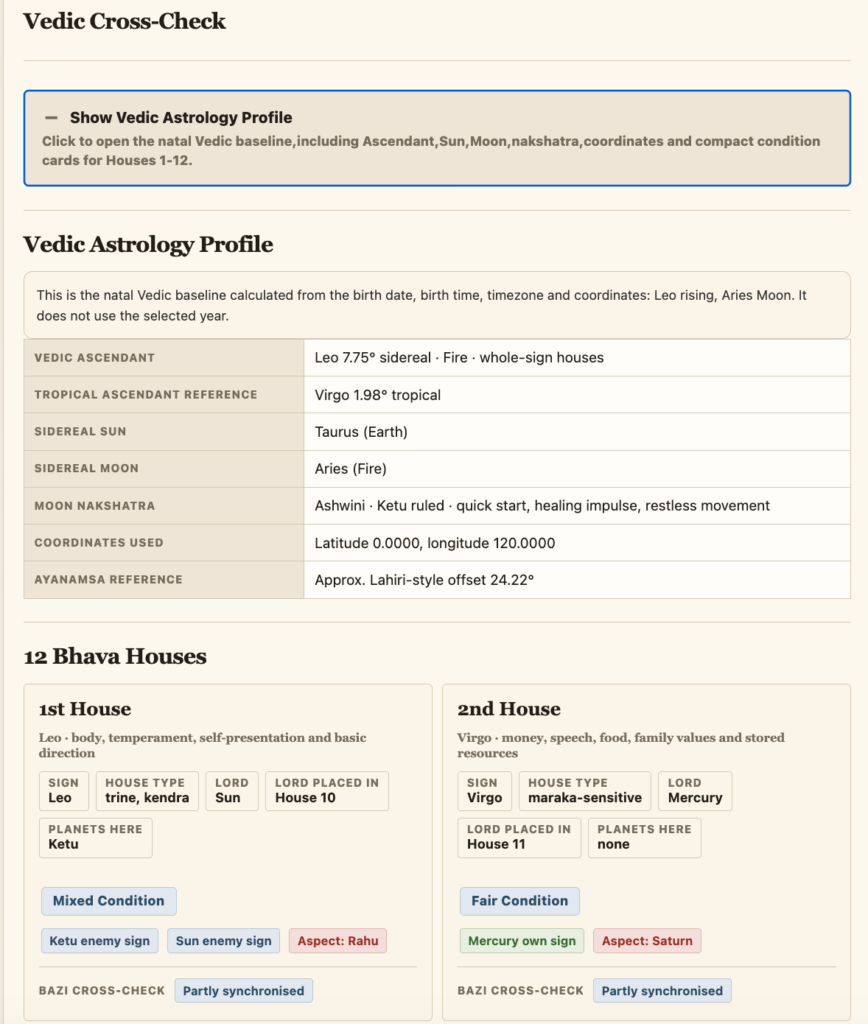
The Vedic Cross-Check adds an independent Jyotisha timing layer to the BaZi chart. It calculates a separate sidereal astrology profile and then compares its major themes with the chart’s BaZi structure, useful elements and selected year. The module uses a sidereal zodiac with Lahiri-style ayanamsa. Birth date, time, latitude and longitude are converted into astronomical time values so that the sidereal Ascendant can be calculated from the birth location. The resulting chart is organised through the Whole-Sign House system, with each planet placed into one of the twelve houses from the rising sign. A tropical Ascendant reference is also shown so users can see how the ayanamsa changes the chart. Its natal analysis covers the sidereal Sun and Moon, the Ascendant, planetary house placements and the Moon’s position within the traditional 27 Nakshatras. The birth Nakshatra is then used to calculate the Vimshottari Dasha sequence, including the current Mahadasha and Antardasha, their approximate date ranges and the remaining planetary-period balance at birth.
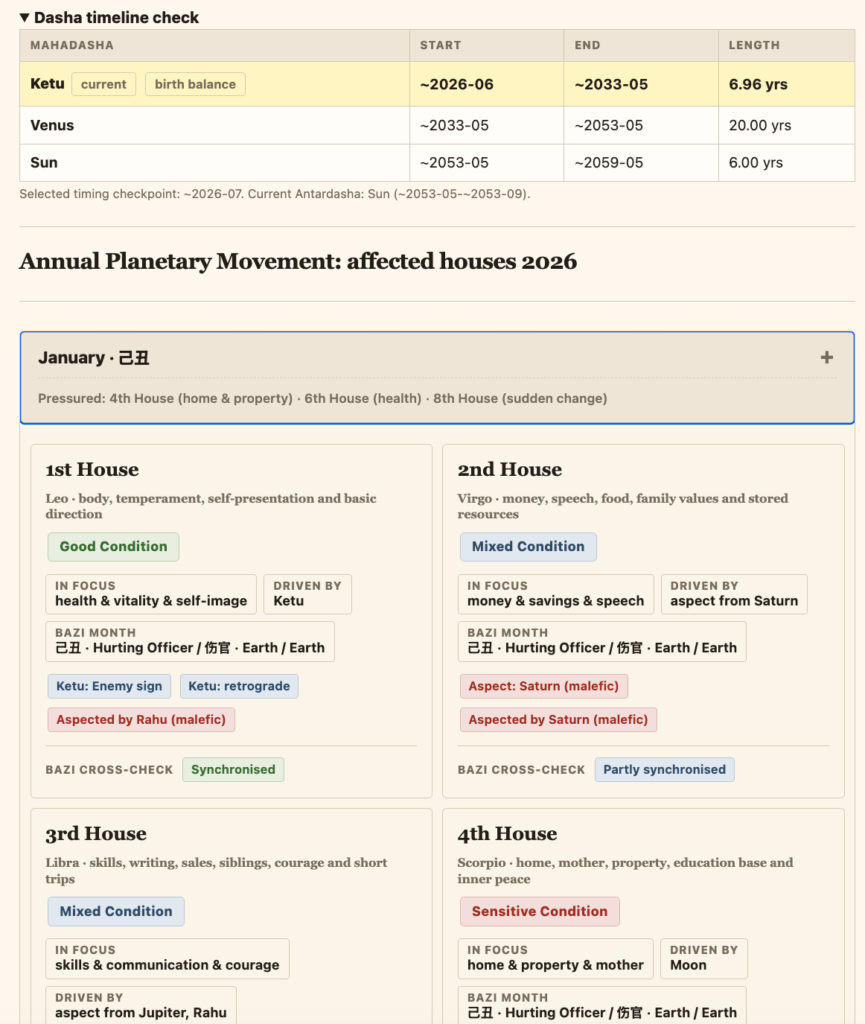
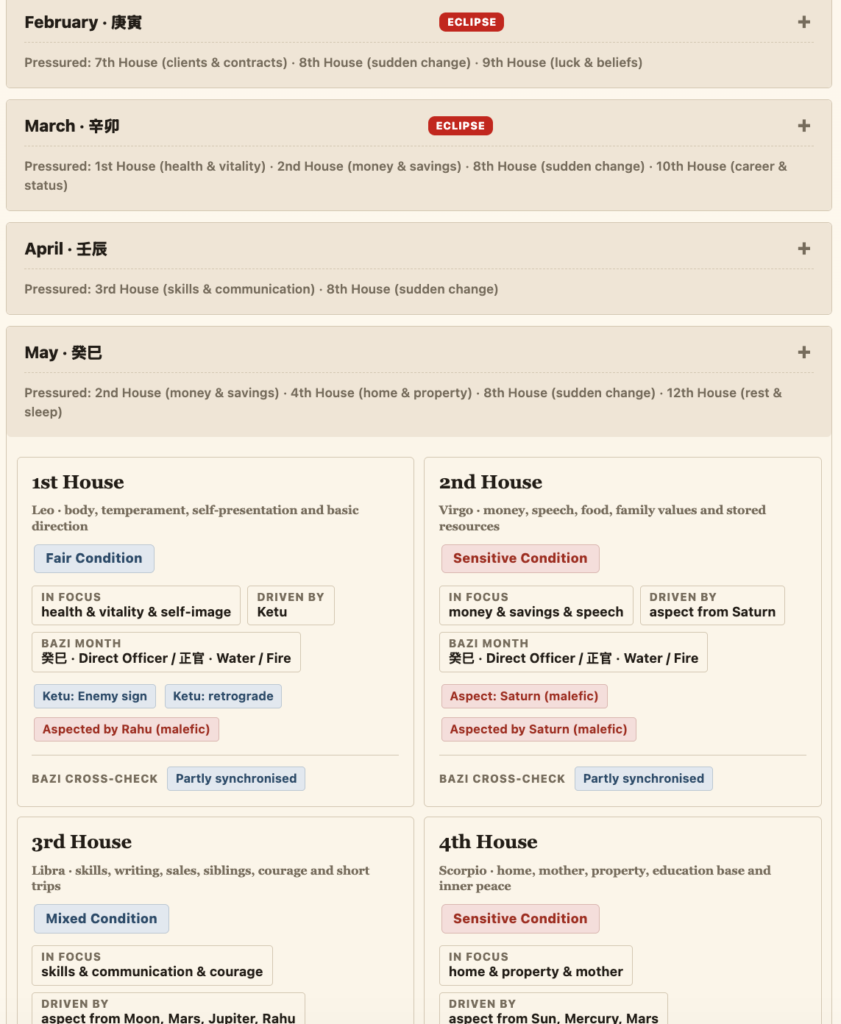
The annual cross-check examines the full Navagraha set used by the module: Sun, Moon, Mercury, Venus, Mars, Jupiter, Saturn, Rahu and Ketu. Their sidereal movements are followed through the selected year to show which natal houses are activated. The engine also evaluates retrograde movement, exaltation and debilitation, combustion near the Sun, planet-to-planet relationships, house-lord dynamics and whole-sign aspects. Sade Sati is tracked. The calculator checks Saturn’s monthly position from January to December against the natal Moon and identifies whether the initial, central or final phase is active. It also constructs a Vimshottari timeline and compares the dasha period, Saturn cycle and planetary movement with the corresponding BaZi year pillar. Eclipse-sensitive windows are scanned by testing New Moon and Full Moon positions near Rahu and Ketu. All the sections are synchronised with BaZi and help identify the status of life area in different periods. The module additionally scans for approximate eclipse-sensitive windows by testing New Moon and Full Moon positions near Rahu and Ketu. These windows are connected to the relevant sidereal sign and natal house, helping identify periods when a particular life area may become unusually concentrated, unsettled or important.
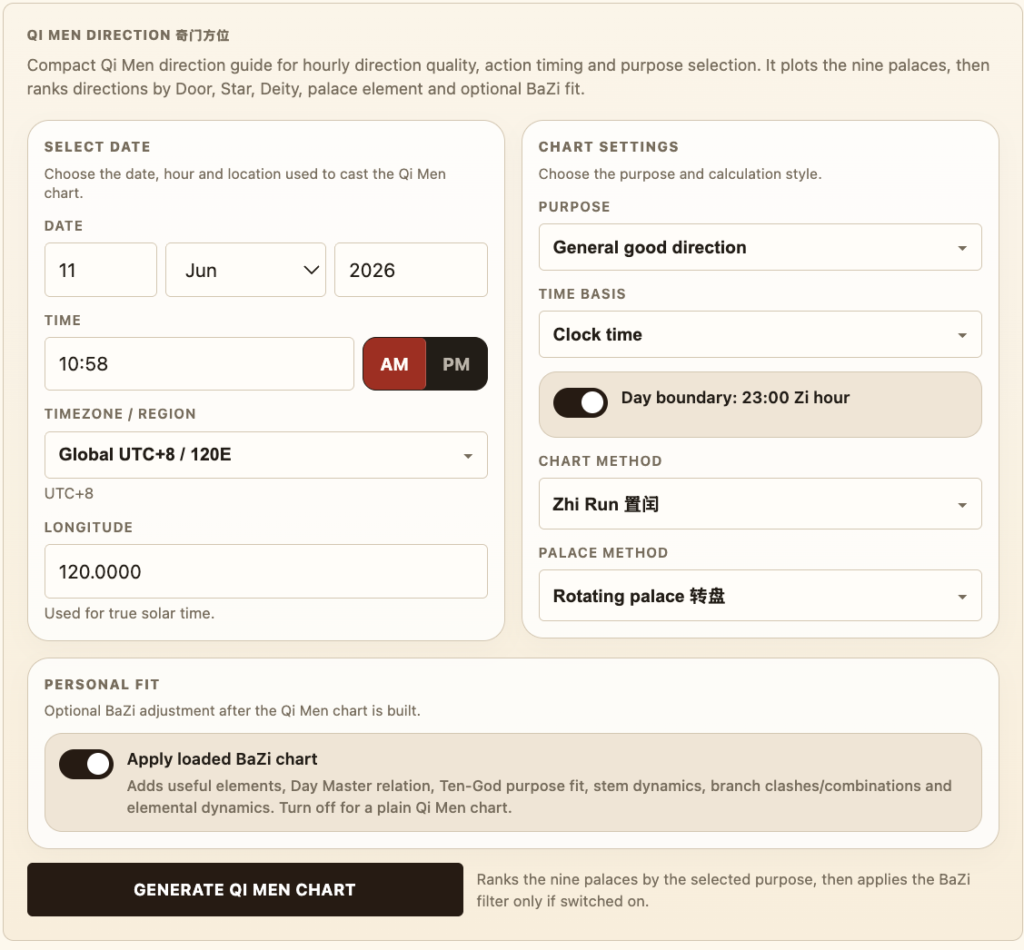
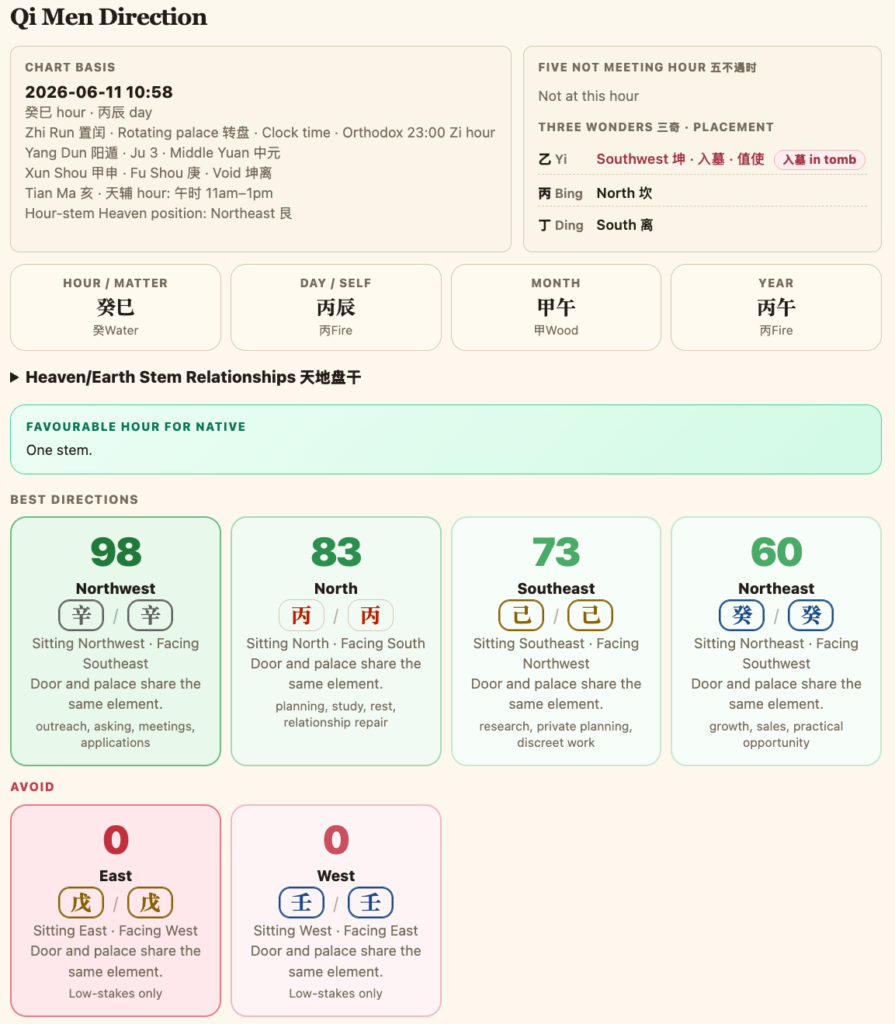
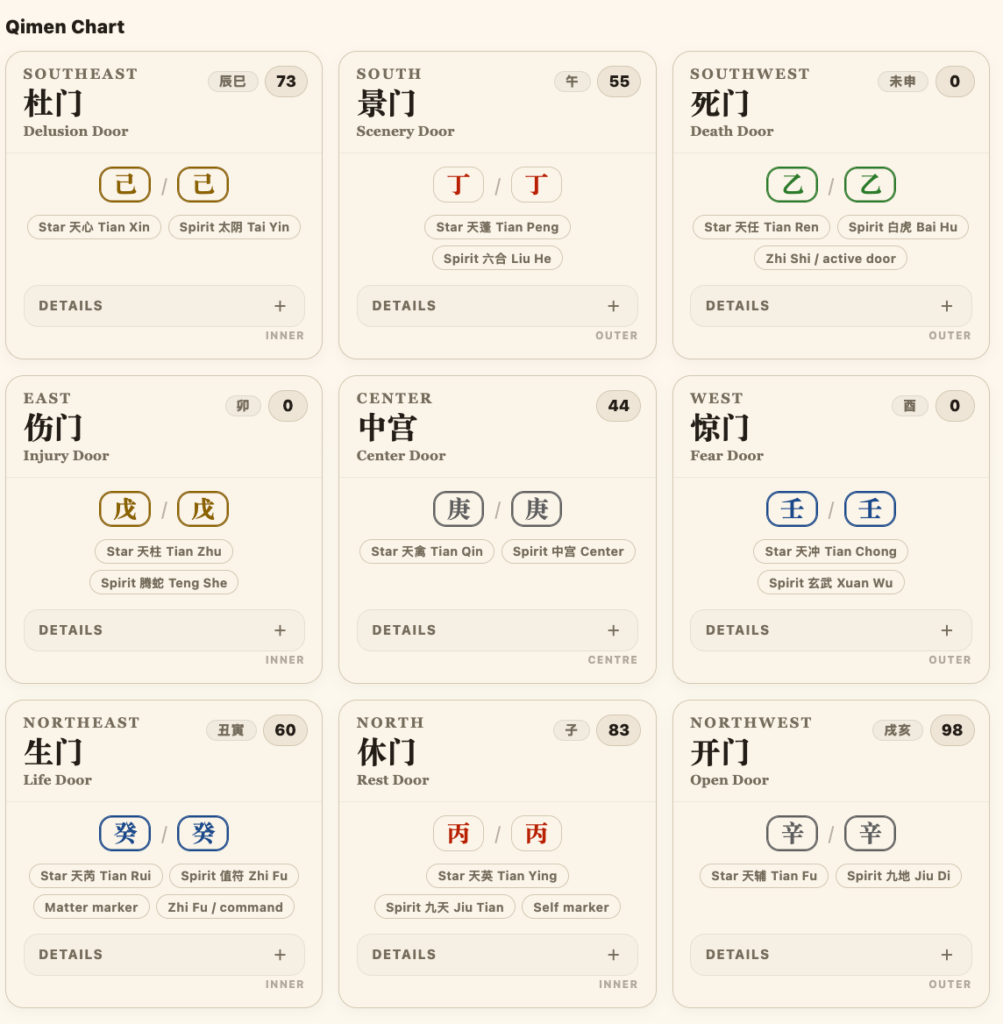
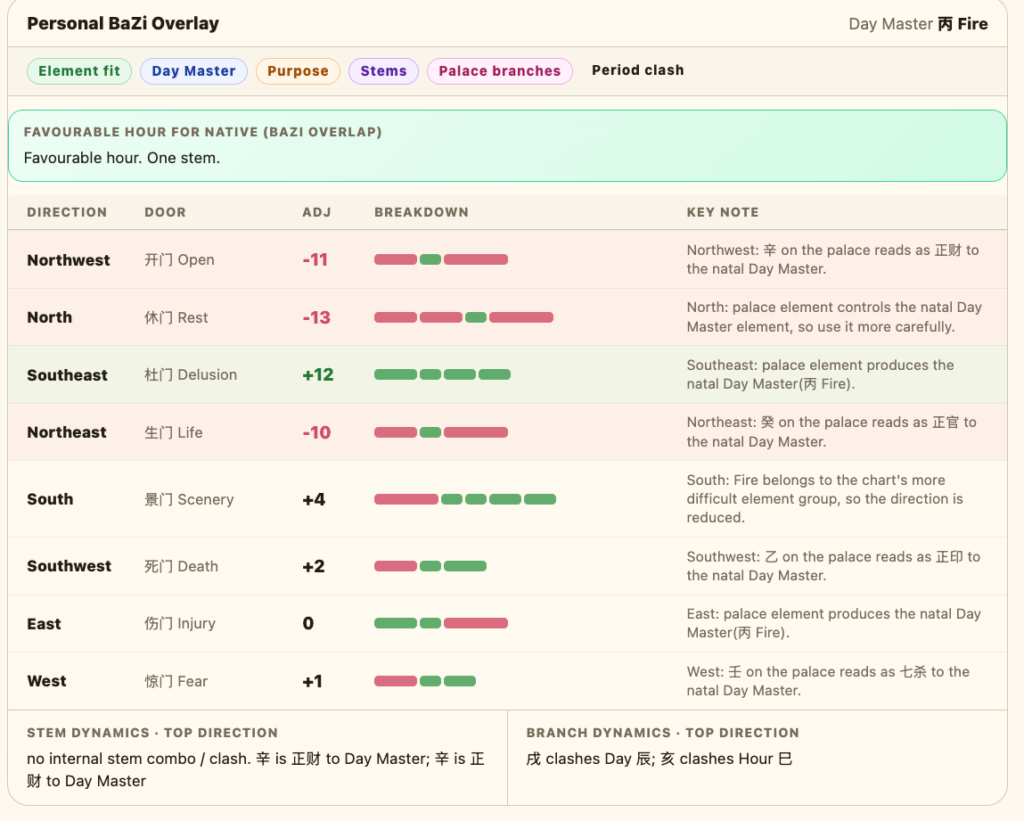
The Qimen Direction module is a practical time-and-direction planning engine based on Qi Men Dun Jia 奇门遁甲. Instead of assigning permanent lucky directions, it constructs a Qimen chart for the present hour or a date and time selected by the user. This allows the recommended direction to change according to the timing, location and purpose of the activity. The engine supports both Zhi Run 置闰 and Cai Bu 拆补 chart-selection methods, together with rotating and flying palace layouts. Each hourly chart can include the Heaven and Earth plates, Eight Doors, Nine Stars and Eight Deities. The calculation also tracks Xun Shou 旬首, Fu Shou 符首, Void palaces, Tian Ma 驿马 and Tian Fu hours, while identifying important formations and relationships within each palace. Every direction (and hour) is evaluated through a purpose-weighted scoring engine . The importance of a Door, Star, Deity, palace element, stem relationship or formation changes according to the selected objective. A direction suitable for negotiation may therefore rank differently for romance, travel, study, employment, business or conflict management.It then presents the strongest directions, usable alternatives and directions that are better avoided, together with an explanation of how each direction may be used. An optional BaZi overlay personalises the Qimen result, giving the best directions as well as the strength of the hour for the natal chart. The module can update results by the hour for immediate planning or calculate a future date and time for planning. Region, time zone and the chosen time basis are incorporated into the chart, with solar-time adjustment available where applicable.
Premium Edition: Saving/Loading Chart, Manual Entry of Longitude and Latitude
Premium Access users can save, name, load and delete charts; all details are saved including Day Boundary and Solar Correction selections. There will also be the option where longitude and latitude can be entered manually for calculations that depend on birth-location coordinates. Manual longitude overrides the selected region’s default longitude, while latitude is used by chart modules that require geographical positioning.